

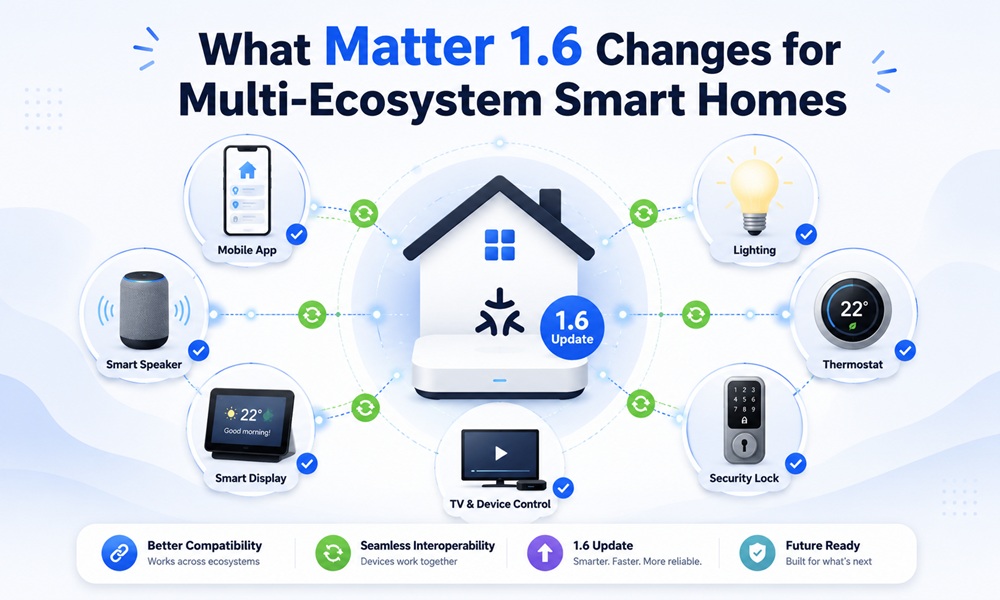
If you live in a single ecosystem, Matter 1.6 will mostly show up as “things feel a little smoother.” If you run more than one — an iPhone household with an Alexa speaker in the kitchen, or a Google-first home with an Apple user in it — this release targets exactly your pain points. Here is what changed, read through the multi-ecosystem lens rather than as a feature dump.
Joint Fabric: the real story for multi-platform homes
To see why this matters, you need the before picture. Matter has always supported Multi-Admin — sharing a single device with more than one platform. Matter 1.4 improved it with Enhanced Multi-Admin, which automated that sharing with a single consent. But under the hood, each platform still kept the device in its own separate fabric — separate logical networks that merely granted each other access.
Joint Fabric changes the architecture. Instead of separate fabrics sharing access, multiple user-authorized controllers co-administer a single, shared data pool. A device added to the joint fabric is simply present in every participating ecosystem — no separate onboarding in each app.
| Enhanced Multi-Admin (Matter 1.4) | Joint Fabric (Matter 1.6) | |
| Model | Separate fabrics that grant each other access. | One shared data pool that multiple controllers co-administer. |
| Adding a device | Onboard once, then share a pairing code to each other platform. | Add to the joint fabric once; it appears everywhere automatically. |
| Best for | A household sharing the odd device across two apps. | Multi-platform homes, new-build handovers, managed properties. |
The CSA is aiming squarely at scenarios that used to be miserable: new-construction handovers (a builder commissions everything, then hands a clean, shareable set to the buyer), households running several platforms at once, and professionally managed properties where a building manager, a tenant, and a service provider all need access at the same time without re-pairing every device three times.
| HONEST CAVEAT
Joint Fabric is a specification, not a button. It only helps once Apple, Google, Amazon, and others actually implement it in their apps, on their own timelines. The CSA was explicit that the path from spec to your phone varies by company — the developer SDK was still showing the previous version at launch. Treat Joint Fabric as “coming,” not “live today.” |
Full NFC commissioning: tap to set up, even before power
Setup has long been Matter’s weak spot, especially for devices installed in awkward places — ceiling fixtures, in-wall switches — that you configure before they are powered or reachable. Matter 1.6 lets you complete the entire commissioning over a single NFC tap, with two-way NFC communication, even before the device is fully powered on.
This is a real step beyond Matter 1.4.1, which could put setup information on an NFC tag but still needed Bluetooth LE to finish the job. For multi-ecosystem installers and anyone wiring up a room of switches, “tap and done” removes a genuinely annoying second handshake.
Thermostat Suggestions: context-driven control, explained
Today’s smart thermostats are surprisingly dumb — they take whatever command arrives last. In a multi-ecosystem home that is a recipe for tug-of-war. Matter 1.6 introduces Thermostat Suggestions: instead of issuing a blunt command, a controller sends a time-bound suggestion that the thermostat evaluates against your stored preferences, your recent manual inputs, and current conditions.
| THE THREE-WAY CONFLICT IT SOLVES
Picture a thermostat linked to Google Home, Apple Home, and a utility energy-saving program. During a peak-energy event the utility suggests a money-saving temperature. At the same moment, a home automation routine tries to cool the house because you just arrived. But you nudged the dial by hand five minutes ago. Under Matter 1.6 the thermostat can recognize that recent manual input, weigh the competing suggestions, and pick the action that best matches your intent — rather than blindly obeying whichever message landed last. When it declines a suggestion, it returns a standardized explanation so the controller knows why. |
This is what the CSA means by context-driven control, and it is the most consumer-visible idea in the release. It respects user autonomy while letting multiple ecosystems coordinate instead of fight.
The quieter core enhancements (that still matter)
Several under-the-hood changes improve how devices describe themselves across ecosystems — useful precisely when more than one platform is reading the same device:
- Device capability and limits reporting — devices state what they can and cannot do in a standardized way, so every controller interprets them consistently.
- Security-sensor event history — sensors can report recent activity, not just their current state.
- Unmounted-state for smoke and CO alarms — an alarm can now signal that it has been removed from its mounting, a genuine safety win.
- Partitioned certificate revocation lists — revocation data is split into smaller, independently updated chunks, so security scales without bloating every device.
Alongside Matter 1.6, the CSA also announced Product Security 1.1, which shifts certification from individual devices toward complete IoT systems — a sign the standard is maturing from “does this gadget pass?” toward “is this whole setup trustworthy?”
Where 1.6 sits in the timeline
Context helps. Matter has been shipping focused releases rather than one giant leap:
- Matter 1.4 (2024) — Enhanced Multi-Admin, energy management groundwork.
- Matter 1.4.2 (2025) — Wi-Fi-only provisioning for cheaper devices; certificate revocation support.
- Matter 1.5 (2025) — cameras, closures (shades, blinds, garage doors), more energy features.
- Matter 1.6 (June 2026) — Joint Fabric, full NFC setup, Thermostat Suggestions, core reporting and security upgrades.
The trajectory is clear: the early releases added device types; the recent ones, including 1.6, are about making the platform livable across ecosystems — which is exactly the promise Matter was sold on.
What Matter 1.6 does NOT do
To keep expectations honest:
- It adds no new device categories — this is a refinement release.
- You will not see a “Matter 1.6” toggle in your app; you will just notice newer products behaving better.
- Features arrive on each vendor’s schedule, so availability will be staggered across Apple, Google, Amazon, Samsung, and the rest.
Frequently asked questions
What is the most important Matter 1.6 feature for multi-ecosystem homes?
Joint Fabric. It lets multiple controllers co-manage one shared set of devices, so a device appears across Apple Home, Google Home, and Alexa without being set up separately in each — a real upgrade over the older share-a-device Multi-Admin model.
How is Joint Fabric different from Multi-Admin?
Multi-Admin (including Enhanced Multi-Admin in Matter 1.4) keeps each platform’s devices in separate fabrics that grant one another access. Joint Fabric replaces that with a single shared data pool that multiple authorized controllers co-administer — fewer copies, less duplicated setup.
What are Thermostat Suggestions in Matter 1.6?
A standardized way for controllers to recommend, rather than command, a temperature change. The thermostat weighs the suggestion against your preferences, recent manual inputs, and current conditions, then chooses the best action and explains itself if it declines — the core of Matter’s new context-driven control.
Do I need new hardware to use Matter 1.6?
Some features (like full NFC commissioning) depend on device hardware, while others arrive through firmware and ecosystem app updates. There is no single switch — support rolls out gradually as manufacturers and platforms implement the spec.
When will Matter 1.6 features actually reach my devices?
It varies by company. Matter 1.6 is available to device makers and platforms now, but each implements features on its own timeline. Watch your ecosystem and favorite brands for rollout news rather than expecting everything at once.
Matter 1.6 will not flip a dramatic switch overnight. But if you juggle more than one smart-home platform, it is the release that finally treats that as the norm — not the edge case.
